
Watering an orchard through a dry summer
We are 200 millimetres down on the season and it is the middle of July. This is what we actually do, and the order in which things get cut.
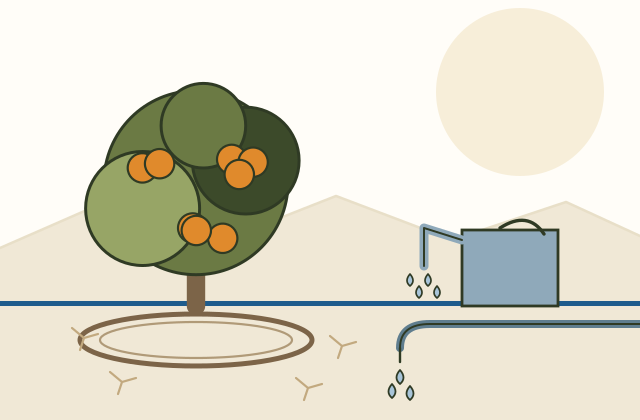
We have had 318 millimetres of rain since last October. The long term average for a season here is somewhere near 520. It has not rained meaningfully since the middle of April and it will not rain again before October, and probably not properly before November. So the question is not whether to irrigate, it is how to spend a fixed amount of water across 144 citrus trees, 18 vegetable beds and about four months.
Fewer and deeper, not little and often
The single most common mistake, and the one we made in our first two summers, is watering a tree a little every day. It feels attentive and it is close to useless. A short daily watering wets the top ten centimetres of soil, which is exactly where the sun and the wind can take it back, and it trains the tree to put its roots up into that top layer where they are most vulnerable. Then you go away for a weekend in August and the tree, whose roots are all in the top ten centimetres, is in serious trouble by Sunday.
A mature orange tree here in July wants somewhere around 90 litres a week. We give that in two goes rather than seven, roughly 45 litres each time, twice a week. It goes on slowly enough to soak rather than run, which on our clay means about ninety minutes on the drip. The soil is wet to forty centimetres afterwards and it stays damp down there for three or four days.
You can check this with a spade and there is no substitute for doing so. Dig a hole thirty centimetres deep next to a tree the morning after you have watered. If it is dry at the bottom, you did not water enough, whatever the timer says.
Basins and mulch
Every mature tree has a basin around it, a shallow saucer of earth about two metres across with a low lip. It exists so that water stays where you put it instead of running down the terrace. On sloping ground with no basin, a good proportion of what you apply ends up watering the row below, and in a dry year that matters.
Inside the basin goes mulch, and plenty of it. Straw, prunings that have been through the chipper, whatever we have. Four or five centimetres. Mulch does two things at once: it slows evaporation from the surface, and it keeps the soil temperature down. We have measured a ten degree difference at ten centimetres depth between a mulched and an unmulched basin on the same afternoon. The mulch is the cheapest water we buy.
The numbers we use in July
- Mature orange tree
- About 90 litres a week, in two waterings
- Young tree, under four years
- About 40 litres a week, in three
- A vegetable bed
- Around 60 litres a day
- Almonds
- Nothing. They are dry farmed and always have been.
- Olives
- Nothing for the established trees. The 2019 planting gets a little.
Before dawn, every time
The irrigation timer comes on at half past four in the morning. There are two reasons and only one of them is evaporation.
The obvious reason is that water applied at two in the afternoon in July partly disappears before it gets into the ground, and what does get in has to fight a soil surface that is at 45 degrees. The less obvious reason is that watering in the evening leaves everything damp overnight in air that is still warm, and that is how you get fungal problems, particularly in the vegetable beds. Before dawn gives you the coolest hours for infiltration and a whole day of drying afterwards.
Reading the trees
Citrus leaves curl and go slightly grey in the middle of a July afternoon. That is normal. It is the tree closing down to save itself and it does not mean anything is wrong. What matters is whether the leaves have come back by seven the next morning. Curled leaves at dawn means the tree did not recover overnight and it is genuinely short of water.
The other signal is fruit drop. Some drop in June is normal and healthy, the tree shedding what it cannot carry. Drop continuing through July is the tree telling you it is choosing between the fruit and itself, and it will always choose itself. In 2025 we had drop into the second week of July, which is why the Valencia crop was a third down.
The order things get cut
In a bad year you do not have enough for everything and pretending otherwise is how you lose something you cannot replace. Our order, worst case first:
- Young trees keep their water no matter what. A four year old citrus that dies is six years of waiting to get back. A mature tree that has a bad summer is a bad summer.
- The vegetable beds keep theirs, because they feed us and because at 60 litres a day for eighteen beds they are not the biggest draw.
- Mature citrus takes the reduction. They will drop fruit and the fruit that stays will be smaller and thicker skinned. They will not die.
- The lawn, such as it is, gets nothing and goes brown in May. It comes back.
- Almonds and established olives get nothing in any year. They are dry farmed and that is the whole point of them.
The borehole
We have a borehole at 74 metres and two tanks, 30,000 and 12,000 litres. The tanks are not storage in any meaningful sense, they are a buffer that lets us pump when we want to and irrigate when the plants want it.
The thing we are careful about is not pumping the borehole hard. We run it in the early morning and let it recover. Pumping a bore flat out through a drought is how a bore that has worked for thirty years stops working, and the water in it is shared with everyone else on this bit of hill whether or not anyone likes to think about it that way.
What we would tell someone starting out
Mulch before you buy anything. Build basins before you buy anything. Both are free and both are worth more than a better timer. And measure with a spade rather than trusting a schedule, because every soil is different and ours is a shallow clay that behaves nothing like sand.
The rest of the water story, the terraces and the tanks and why the ground here holds so little, is on the land page.
Where to next
The soil, the terraces, the borehole and the tanks.
The same problem at bed scale, a year on.
What the 2025 drought did to the citrus crop.