
Almonds
Almonds are the least reliable crop we have and the one we would least like to lose. Sixty one trees, most of them older than we are, and a harvest that can halve on the strength of one cold week in January.
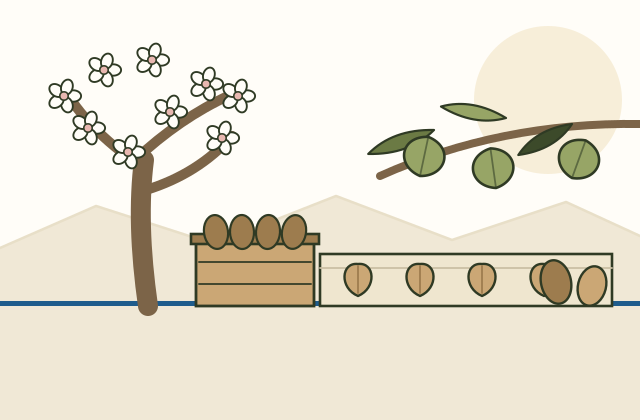
Harvest September 61 trees
Blossom in January, harvest in September, and everything in between is weather you cannot do anything about.
What is planted
Sixty one trees on the two upper terraces and along the northern boundary, where the ground is thinnest and nothing else would do much. Almonds tolerate that. They are the traditional dry farmed tree of this region and they were planted here for the same reason they were planted everywhere in the Algarve, which is that they will crop on land that will not carry anything else.
Ours are almost all the old local types, Durazia and Côco, hard shelled and small kernelled. They are nothing like the soft shelled modern varieties. You cannot crack them in your hand and the yield of kernel to nut is poor, somewhere around a quarter by weight against a third or better for a modern orchard. In exchange they need no irrigation, they have survived on this ground for decades, and the flavour is much stronger. We would not replant with anything else, though we understand entirely why a commercial grower would.
Eleven trees have gone in since we arrived, replacing ten that died or came down, and all grown on from local stock rather than bought in.
The blossom, and the problem with it
Almond blossom here starts in the middle of January and is mostly over by the first week of February. It is genuinely the thing people come to the Algarve in winter to see, and it is also the single biggest risk in the crop. The trees flower before there is any leaf on them, in the coldest and wettest part of our year, and they need insects flying to set fruit.
A cold, wet, still week during blossom means the bees do not fly, the flowers are not worked, and the crop is gone before spring has started. There is no remedy. We keep nine hives partly for the honey and largely for this, and even so, a bad blossom fortnight is a bad year and you find out in January what September is going to look like.
Almond year
- Mid January
- Blossom opens. Everything depends on this fortnight.
- March to June
- Hulls fill. No irrigation, the trees are on their own.
- July to August
- Hulls dry and start to split.
- Late August to September
- Harvest, hulling, drying.
- December
- Pruning, and only what needs it.
How we harvest
The old way, which is also the only way that makes sense at our size. Sheets go down under the tree, someone gets up a ladder with a long cane and knocks the branches, and the nuts come down. It is loud, dusty work and it takes two people per tree to do it quickly. Sixty one trees takes us about nine days spread over three weeks, because the trees do not all come ready together and you cannot knock a tree twice without doing damage.
Then hulling, which is the tedious part. The green hull has to come off, and by harvest it is mostly dry and splitting so it comes away with pressure, but not always. Anything still tight gets left in a shallow crate for a few more days. After hulling the nuts go on racks in the shade, not the sun, for two to three weeks until the kernel rattles. Then they go into sacks, in shell, and stay that way until we need them.
We crack in small amounts through the year rather than all at once. An almond in its shell keeps for a year without any trouble. A cracked kernel starts to go stale in a couple of months, and a ground one much faster than that, which is why almond butter is made in small runs rather than in one big autumn session.
What a bad year looks like
2025 was our worst almond year. The blossom fortnight in January was wet and cold, three days of rain in the middle of it, and the set was visibly poor by March. Then the summer had no water in it. We took about half of a normal crop, and the kernels that did fill were small.
There is also a slower problem. Several of the oldest trees are declining and two came down in a wind in 2023. They are at the end of a natural life and there is no clever fix. We replace what we can, but a replacement almond takes five or six years before it does anything worth counting, so the tree we plant this winter is a tree for 2032.
Recent crops, in shell
- 2023
- 410 kg
- 2024
- 348 kg
- 2025
- 196 kg. Poor blossom, dry summer.
- 2026
- Being harvested now. Better than last year, not a full crop.
Where the crop ends up
Most of it is sold in shell locally. What we keep goes into Almond butter, roasted and ground in small batches, and into the kitchen. The old local varieties make a butter that tastes much more of almond than anything you can buy, and it is also the reason the jar is not cheap: the kernel yield from these nuts is low and the cracking is slow.
If you want to understand why we care so much about the hives, this is the page that explains it. The bees are here for the almonds as much as for the honey.
Where to next
Roasted and ground in small runs, 280 gram jar.
Nine hives, kept as much for the January blossom as for the jars.
Why the thin ground on the upper terraces suits almonds and nothing else.