
The land
Four point two hectares on a south facing slope in the limestone country behind the Algarve coast. Two point six of it is worked. The rest is scrub and we leave it that way on purpose.
Where it is
Inland from the coast, in the belt of limestone hills that sits between the beaches and the higher serra behind them. This is the barrocal, and it is a specific kind of country: pale rock close to the surface, red clay soil where there is any soil at all, carob and wild olive on the uncleared ground, and terraces wherever anybody has ever tried to farm it.
We are not going to publish an address or put a pin on a map. It is a family home as well as a smallholding and the harvest days are the way to visit. If you are coming to one, you get directions when you book.
The soil
Shallow red clay over limestone. In the best parts of the bottom terrace there is forty centimetres of it. On the top terrace, where the almonds are, there is fifteen, and in places you hit rock with a spade at ten. That single fact decides most of what happens here.
It is alkaline, which is normal over limestone and which rules out a whole category of plants people arrive wanting to grow. When we had it tested in 2017 the organic matter in the orchard ground was 1.2 per cent, which is very low and is what a decade of nothing plus decades of ploughing before that will do. In the vegetable beds, which have had compost and mulch on them every year since, the last test came back at 3.1 per cent. In the orchard, where all we do is mulch, it is nearer 1.9. It moves slowly.
The plot in numbers
- Total
- 4.2 hectares
- Worked
- About 2.6 hectares
- Scrub and carob
- About 1.6 hectares, left alone
- Terraces
- Seven, from narrow strips at the top to the wide bottom one
- Soil depth
- Ten to forty centimetres over limestone
- Rainfall
- Long term average near 520 mm. Last four seasons: 531, 372, 318, 470.
The terraces
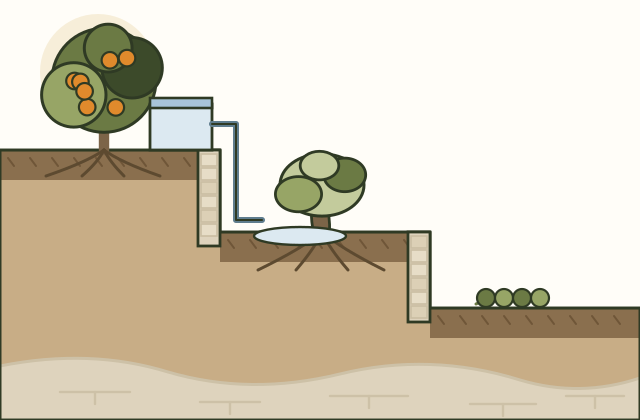
The slope is terraced from top to bottom and it was terraced long before anyone alive was here. The retaining walls are dry stone, built from the limestone that came out of the ground when the terraces were cut, and some of them are clearly very old. Nobody has ever been able to tell us how old and we have stopped asking.
A terrace does two things. It gives you flat ground to work on, and much more importantly it stops water running off. On a bare slope in this soil, a heavy winter downpour runs straight down the hill taking the topsoil with it. On a terrace, the same rain sits and soaks. The terraces are the reason there is any soil left here at all.
When we arrived, about 180 metres of wall had collapsed or was going. Rebuilding it was the first big job and it took two winters. Dry stone walling is slow and there is no shortcut. You sort the stone, you place each one so it sits on two below it, you tie the wall back into the bank every so often with a long stone, and you do not use cement. We were taught it by a neighbour who has done it since he was fourteen and we are still not good at it.
Water
Everything here comes back to water. The long term average rainfall is somewhere near 520 millimetres a season and essentially all of it falls between October and March. From April to October you get nothing, so every drop that keeps the trees alive in July fell in January.
- A borehole at 74 metres, which is the main supply. It was here when we came, silted up and unusable, and cleaning it out was the single most expensive thing we did in the first year.
- Two tanks, 30,000 and 12,000 litres. These are a buffer rather than storage. They let us pump when the borehole is happy and irrigate when the trees need it.
- An old well, which we cleared and which holds water in winter. We do not rely on it and it is essentially a backup and a nice thing to have.
- Drip lines throughout, on timers, running before dawn. The reasoning is in the note about watering through a dry summer.
We are careful about how hard we pump. A borehole that has worked for thirty years can be ruined by being run flat out through a drought, and the water underneath this hill is not only ours.
What was already here
The plot had been abandoned for about twelve years when we bought it. Abandoned in this climate does not mean overgrown in the way it would in England. It means dry grass, cistus and thorn coming back in from the edges, dead wood in every tree, and a lot of collapsed stone.
- About seventy orange trees, of which fifteen did not survive our first two years. Old, unpruned, hollow in the middle, still fruiting in a poor way.
- Around sixty almond trees, most of them old and several already dead standing.
- Twelve olive trees on the bottom terrace, Galega, big and completely unpruned.
- Thirty or so fig trees, which were the only thing that did not need rescuing.
- Carob trees along the boundary and through the scrub, which we have not touched and do not intend to.
- The building, which had a roof over about half of it.
What we planted
- Eighty nine citrus trees between 2018 and 2022, filling gaps, replacing the ones that died and putting in every lemon we have, including the four bitter oranges that make the marmalade possible in quantity.
- Eighty four olive trees in 2018 and 2019, Galega, Cobrançosa and twelve Maçanilha Algarvia for the table.
- Eleven almond replacements, grown on from local stock rather than bought in.
- Five quince trees in 2018, which came into crop in 2022 and give us the quince paste.
- Four fig trees from cuttings off the best of the old ones.
- Eighteen raised vegetable beds on the bottom terrace, built in 2019.
How it was brought back
Slowly, and in an order that was mostly obvious once we stopped trying to do everything at once.
- Water first. The borehole in 2017, then tanks, then the main irrigation lines. Nothing else was worth doing until there was water.
- Walls second, through the winters of 2017 and 2018. A terrace with a collapsed wall is a terrace that is washing away every time it rains.
- Clearing, which mostly meant taking out dead wood and cutting back the scrub that had come in from the edges. We did not clear the far end and we still have not.
- Pruning, over three years rather than one. We got this wrong in the first winter, cut too hard, and paid for it. That whole story is in the note on pruning citrus.
- Planting, from 2018 onwards, once we knew what the water would actually carry.
- Soil, continuously and forever. Everything that comes off the trees goes through the chipper and back on the ground. We have never taken a bonfire's worth of prunings off this place except for diseased wood.
The part we do not farm
About 1.6 hectares at the top and the western edge is scrub: carob, wild olive, cistus, rosemary, thyme and whatever else wants to be there. We could clear it and plant it. We are not going to.
Partly that is because it would need water we do not have. Mostly it is because it is where everything lives. The bees work it from January, the wildflowers in it are a large part of what the honey tastes like, and the birds and the lizards that keep the pest pressure down in the orchard come out of it. A cleared hillside would be a bigger farm and a worse one.
What we are not
We are not certified organic. We do not use herbicides, we have not used a synthetic insecticide since 2019, and we feed the soil rather than the plant. But we have not gone through certification, and we are not going to claim a label we do not hold. The full reasoning, which is mostly about cost and paperwork at our scale, is in our story.
Where to next
Six things, in detail, including what a bad year does to each.
How we came to the plot and what the first years were actually like.
What the water numbers mean in practice in July.