
Olives
Ninety six trees, twelve of them old enough that nobody knows who planted them. The harvest is one long fortnight in November and it is the busiest the place gets all year.
November Pressed within a day
Everything about olives is decided by when you pick. A week early gives you green, bitter, low yielding oil that keeps. A week late gives you more oil, softer flavour, and something that will not last the year.
What is planted
Twelve old trees came with the plot, on the bottom terrace where the soil is deepest. They are Galega, which is the traditional Portuguese olive and still the most planted variety in the country. Hollow trunks, wide crowns, and they had not been pruned in a long time. We took four years opening them up and they crop properly again now.
The other eighty four went in over 2018 and 2019, in rows on the lower two terraces:
- Galega, 44 trees. Small fruit, low yield, and the flavour we actually want in the oil. It is a difficult variety commercially, which is why plantings of it have been falling for years, and it is the reason our oil tastes like it does.
- Cobrançosa, 28 trees. More reliable, better yielding, holds up to disease better. It carries the blend when the Galega has a poor year, and it does the same job in the tin as a stable ingredient does in any recipe.
- Maçanilha Algarvia, 12 trees. The local table olive. These are not for oil at all, they are picked green and cracked for the jars.
When we pick, and why the date matters
The oil trees come off in the first three weeks of November, when the fruit is turning from green to purple but before it goes black. That point is a compromise and everyone in the region argues about where exactly it sits. Pick earlier and you get less oil per kilo, more bitterness, more of the green pepper catch at the back of the throat, and an oil that will still be good in eighteen months. Pick later and the yield goes up by a third, the oil is rounder and easier, and it will be tired by the following summer.
We pick early. That is a preference, not a fact, and it costs us real volume. In 2024 we took 1,180 kilos of fruit and got 168 litres of oil out of it, which is a yield of about 14 per cent. A neighbour picking two weeks after us that year was getting nearer 19.
The Maçanilha for the table comes off earlier still, in the second half of October, hard and green. Those are cracked, put into water for a week with a change every day, then into brine. There is a full account of it in the note on curing olives at home.
Harvest, hour by hour
- Early morning
- Nets down under the row. Everything after this depends on the nets sitting flat.
- Morning
- Combing the branches with hand rakes, working from the outside in.
- Midday
- Fruit gathered off the nets, leaves and twigs picked out, into crates.
- Afternoon
- Crates weighed and loaded. Nets moved to the next row.
- Same day or next
- To the mill. Fruit sitting in a crate for two days makes worse oil, and there is no argument about that one.
How it is picked and pressed
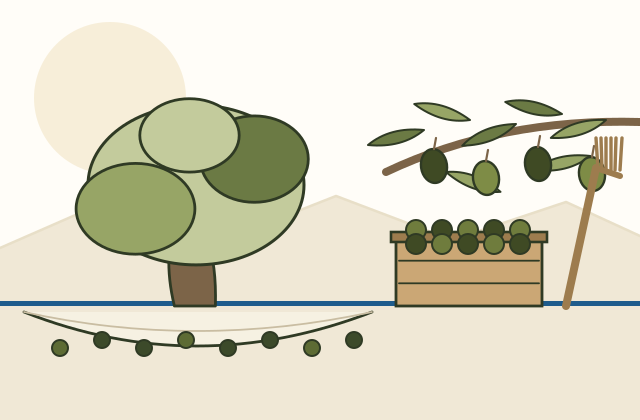
Nets on the ground, hand rakes through the branches, no machinery. It is slow, it is hard on the shoulders, and at our scale it is the only sensible option. A shaker makes sense at ten times this size. Ninety six trees takes six of us about eleven days.
The fruit goes to a small local mill, which we are not going to name, in batches. We press within a day of picking wherever we can, and never more than two. Olives start to ferment in the crate almost immediately and you can taste the difference in oil pressed from fruit that sat over a weekend. It comes back cold pressed and unfiltered, we let it settle in tanks for about six weeks, rack it off the sediment, and bottle from December onwards.
The oil is cloudy for the first month or two and then clears. Nothing is added to it and nothing is taken out except what settles.
What a bad year looks like
Olives alternate. A heavy year is followed by a light one and the tree does that on its own, regardless of what you do. Layer a drought on top of the light year and it gets thin. 2025 was both: an off year in the natural cycle and the driest season we have had. We took 640 kilos and pressed 84 litres, which is half of 2024.
The oil itself was not bad. Drought fruit is small and the flesh to stone ratio is poor, so the yield collapses, but what oil there is tends to be intense. That is not a consolation when you are trying to fill bottles, but it is true.
Four years of oil
- 2022
- 1,340 kg picked, 191 litres
- 2023
- 890 kg, 122 litres. Off year.
- 2024
- 1,180 kg, 168 litres
- 2025
- 640 kg, 84 litres. Off year and drought together.
Where it ends up
Into 500 millilitre bottles as Cold pressed olive oil, and into the chilli oil, which is the same oil with our own dried chillies steeped in it. The Maçanilha goes into brine and comes out as Table olives about four months later.
The Olive harvest and pressing day in November is the one day of the year where you can see the whole chain, tree to net to crate to mill, in a single day. It is also the hardest of the four days and we would rather people knew that before booking.
Where to next
Galega and Cobrançosa, picked early, 500 ml bottle.
A full November day on the nets, 55 euros, lunch included.
Cracking, water changes, brine, and how long it really takes.