
Pruning citrus
We inherited seventy orange trees that nobody had touched in a decade, cut too hard in our first winter, and learned the lesson the expensive way.
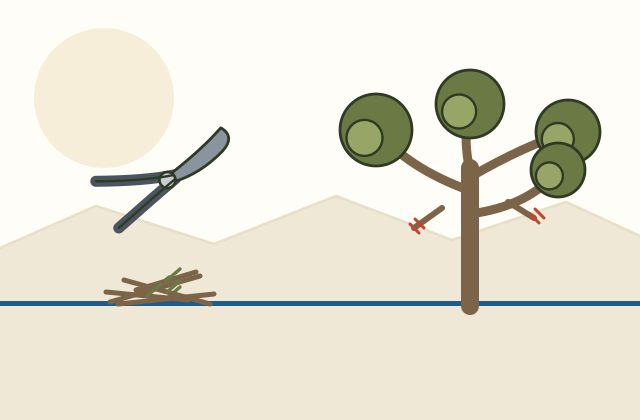
Citrus does not need much pruning. That is the first thing, and it is the opposite of what the tools in the shed suggest. An orange tree left alone will crop. What it will not do is crop well, or let light into the centre, or let you reach the fruit, and a tree nobody has touched for ten years will do all of its cropping in a shell around the outside with a dead thicket in the middle.
When
After the harvest and before the spring flush. Here that means late February into March. On our later varieties it means waiting until the fruit is off, which pushes the Valencia trees into a different slot entirely, and in practice we prune the early trees in February and the Valencias after they finish in July, accepting that summer pruning is a compromise.
Do not prune in December or January. A cut made before the coldest weeks leaves the tree with open wounds and no growth going on, and if you then get a frost you lose more than you cut.
What comes out, in order
- Dead wood. All of it, every year, no argument and no limit. It is not part of the percentage you are allowed to take.
- Anything crossing or rubbing. Two branches touching will wound each other and the wound is where problems start.
- Water shoots. The vertical whips that come straight up out of a main branch, growing fast and straight. They will never fruit usefully and they shade everything below them. Take them off at the base, cleanly.
- Whatever it takes to get light into the middle. This is the actual objective. A citrus tree fruits where light reaches, and a closed canopy is a hollow tree.
- The skirt. Anything hanging low enough to touch the ground or the mulch. Fruit on the ground gets splashed with soil, and low branches are a route in for ants and rot.
The mistake we made
In our first winter, 2017 into 2018, we took a row of neglected trees and opened them right up in one go. It looked much better. What happened next was two things. The trees responded to a hard cut by throwing out water shoots everywhere, so by June they were denser than before we started, and we had a summer of cutting them off again. And the newly exposed bark on the main branches, which had been shaded for a decade, got burned in the June sun. Bark that has never seen direct light burns like skin does. We lost two branches outright and one whole tree over the following two years.
The rule we should have followed, and now do: no more than a fifth to a quarter of the canopy in a single year. A really neglected tree is a three year project. Take a third of what you want to take, each year, for three years.
If you do expose bark
Paint it. A thin lime wash, or a water based white paint diluted by half, on the exposed trunk and main branches. It looks strange for a season and it stops sunburn completely. Every old orchard here has whitewashed trunks and that is why.
How to cut
Clean cuts, sharp tools, and no stubs. Cut back to the branch collar, the slight swelling where the branch meets the one it grows from, and not flush with it. The collar contains the tissue that closes the wound. Leave a stub and it dies back and rots inward. Cut into the collar and the tree cannot seal it.
Do not paint wounds with sealant. It was standard advice for decades and the research turned against it: sealant traps moisture behind it and slows the tree's own compartmentalisation. A clean cut in the right place, left open, heals better.
Clean tools between trees if you have any suspicion of disease. A wipe with alcohol takes five seconds. We did not do this for our first two years and we were lucky.
What we do not do
We do not top the trees to a uniform height. A hedge shaped citrus block looks tidy and does most of its fruiting on an outer skin, and at our scale there is no benefit to it.
We do not prune for a heavier crop, because it does not work like that. Pruning a citrus tree tends to reduce next year's crop slightly and improve the size and quality of what there is, plus your ability to get at it. If someone tells you a hard prune will double your oranges, they are selling something.
The prunings
Everything that comes off goes through the chipper and back onto the ground as mulch, which is where it is worth far more than in a fire. The one exception is anything diseased, which is burned. A citrus tree that produces its own mulch is doing you a favour and it took us three years to stop making bonfires out of it.
Where to next
The block these trees are in, and what is planted.
The first years, including the winter we cut too hard.
The other half of keeping citrus alive here.